

Introduction
Tile placement board games are as straightforward as they sound, players place tiles down to forward the games systems or mechanics and score points based on how well they do it. To speak more broadly of the genre, tile placement board games can involve laying down tiles to form patterns, like Azul, which players then score, or to create a reveal landscapes that players interact with, as in games like Carcassonne or Forgotten Depths.
We consider tile placement a mechanic in board games, made interesting by rules around placement of tiles, or scoring of combinations of tiles, as seen in games like Cascadia and Akropolis. Some games add more flavour round the tile placement through.
Examples of tile placement / tile-laying board games
We have some favourites of our own when it comes to tile placement games, with Joshua swearing love to games like Carcassonne and Akropolis, while Anjali enjoys games like Azul and Cascadia. There’s loads of other fun tile placement games we’ve heard about and have been itching to try, like Calico, Castles of Mad King Ludwig, Forgotten Depths, Isle of Skye, Cacao, Tigris and Euphrates, Suburbia, and Arboretum to name a few.
:strip_icc()/pic7229993.jpg)
:strip_icc()/pic4964039.png)
:strip_icc()/pic8124431.jpg)
We’ve currently got our eyes on Castles of Mad king Ludwig as the game is more complex than some of the other tile-laying games we’ve played before, with social elements and resource management. Anjali’s got her eyes on Forgotten Depths for its RPG-esque feel, and Calico as it looks super cozy and she enjoys knitting quite a bit… and has been knitting a sweater for two years. Its a complicated relationship she has with that pattern.
How long can a game take to play?
As with most other board game genres, games can take anywhere from minutes, to hours, to days, and tile placement board games are no different.
Nonetheless, most of the tile placement board games that we’ve played have been quick, with most games taking about an hour on average, save for the first time time we play, which may have taken much longer because we’re determining mid game the best course of action on how we’re going to win.
Why we love this mechanic
Tile placement board games are often really satisfying for two main reasons that Joshua and I can both agree on
- Tiles are tangible and give you something physical to place down
- They fit together to form satisfying shapes and patterns which are (often) great to look at!
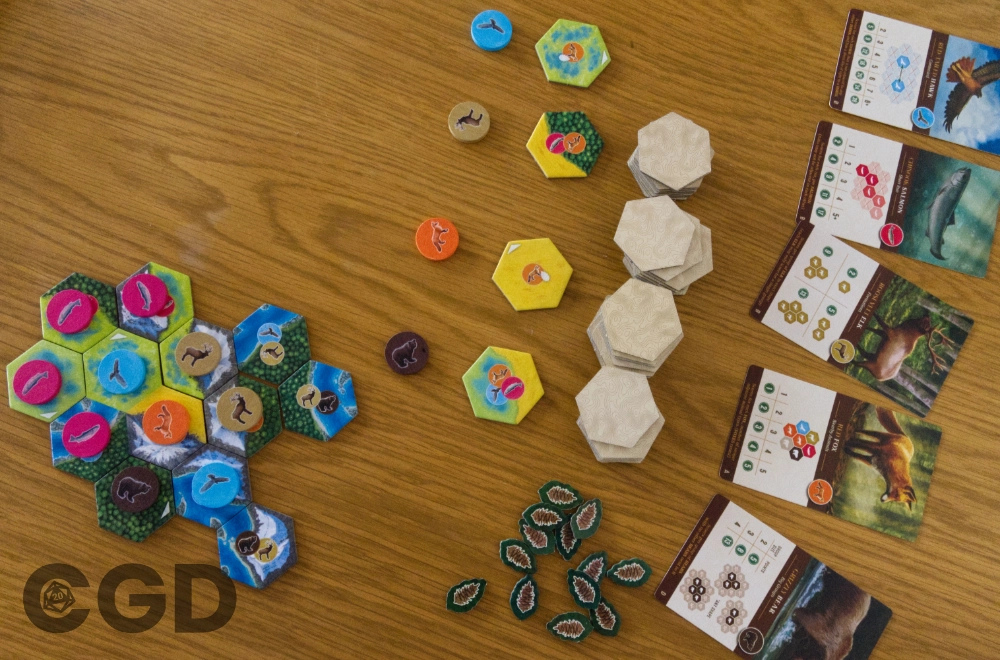
Unsurprisingly the above is true for most games. Apart from that, tile placement as a mechanic, has a fun RPG element to it with players often pulling from the same pool and competing for various tiles to boost scores. Cascadia and Akropolis rely on this slight conflict as players build up their game board for competition, and results are often tough to predict till the end.
Who might enjoy tile placement games?
If you’re someone that likes to see game boards build up, board games with tile placement mechanics scratch that itch really well, and bonus points, you often get to see pretty patterns emerge by the end of a game.
We’d also recommend the tile placement mechanic to players who enjoy puzzle games or slightly more zen games. There’s many games with varying levels of competition as well, and we expect there’s something for everyone!
As an aside, with games at varying complexity levels, tile placement board games are great to use as a stepping stone to get players into more complex board games. Thanks to the nature of the tile placement mechanic, every move is tangible and often give players an immediate sense of direction.
This mechanic also allows for players to grasp the changes on the game board whether shared or singular as the board gets build up over time and changes are usually quite visual.
What are some good tile placement / tile-laying board games to start with…?
/pic5100691.jpg)
Cascadia
A habitat building board game and we’d say a good choice for those who enjoy puzzles. A nice relaxed Sunday afternoon game.
Forty-five minutes to an hour of relaxed habitat building for high scores around animal and landmass formations.
FlatOut Games published Cascadia, and other games like Calico, Verdant, Knitting Circle, Nocturne and many more!
:strip_icc()/pic6973671.png)
Azul
Another fun tile placement game where you're building gorgeous wall patterns. Perfect for family fun or relaxed game nights.
A relatively quick game that often wraps up in 30-45 minutes.
Initially published by Plan B games, and later acquired by Asmodee games, Plan B published many versions of Azul to tickle your fancy
If you enjoyed what you just read about tile placement games, we’ve reviewed Azul, and highly recommend it for a quick relaxed game night. Go check it out!
:strip_icc()/pic6544250.png)
Carcassonne
A great start for entry to complex tableau-building board games with tile placement mechanics, Carcassonne is perfect for competitive game nights with light strategic thinking.
Based on the mood at the table, a game can take 30-45 minutes upto an hour.
Hans im Glück is the original publisdher of Carcassonne, and have published many more expansions and variants fo the beloved franchise.
:strip_icc()/pic6705097.jpg)
Akropolis
A light-mid weight strategic tile placement game with light elements of resource management. Recommended for an afternoon of fun.
Familiarity determines whether, a game can take 20-30 minutes or upto an hour.
Gigamic published Akropolis and many other games like Yogi, Looot, Panic Lab, katamino and more.