

/pic1912529.jpg)
Takenoko is an interesting take on tile laying and resource management board games, with the game requiring you to not only grow the bamboo, but also take it down to keep the cycle running. There’s three overlaying game systems, which includes tile-laying, movement action of the gardener and panda to grow and cull bamboo, and finally the weather system which gives you some bonuses to make the game more interesting.
Our Couple’s Review on Takenoko
Anjali (6/10)
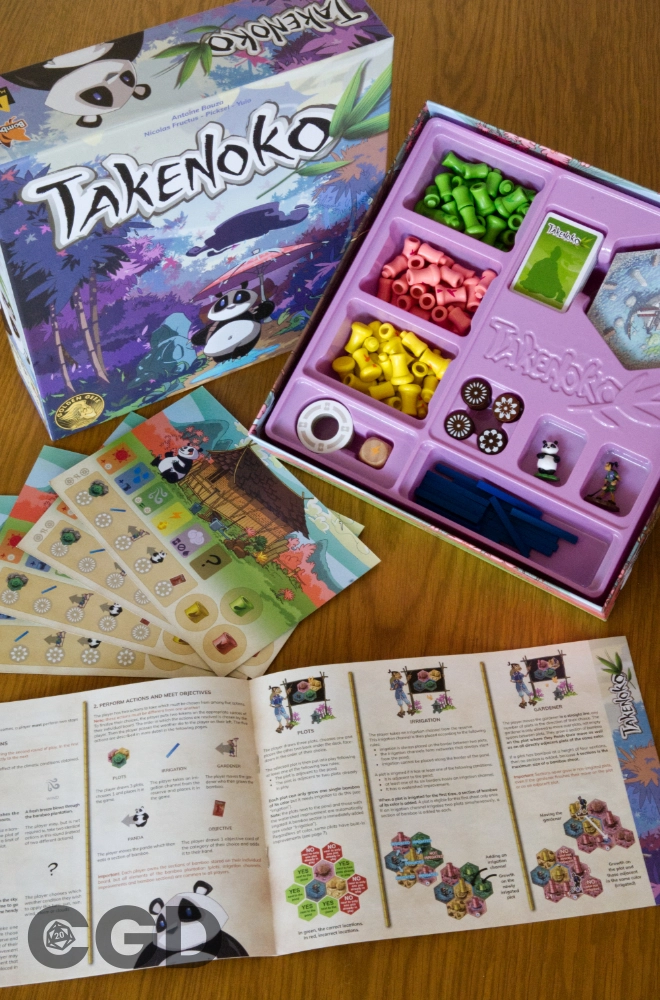
Now before we can get into the gameplay, we need to talk about the art style… or at least, the amount of art direction. Takenoko is a mish-mash of three distinct art styles that don’t necessarily see eye to eye. Between that and the not too well designed inserts for the game, we did have to dock a couple points.
The gameplay? The mechanics and systems are quite satisfying, but the execution and balance leaves something more to be desired. Once you get into the game, the mechanics feel good to play, but highly unbalanced between the movement of the gardener and panda, placement of modifiers and score cards. Unless you collect several score cards and wait to put them down as achievements, the game is far too short to achieve many of the gardener’s score cards.
While the game was enjoyable, it certainly leaves much to be desired in terms of polish, both for the physical game as well as its systems.
Joshua (6/10)
Why are there three distinct art styles??? And also why aren’t the inserts perfect for the game… You could tip this over once and everything would go everywhere… sorry, not okay.
While the game is meant to be strategic, more often than not you’re reacting to what’s taking place on the board. Since all three players have their own objectives and all of you are moving both the gardener and panda, it can sometimes be really difficult to achieve goals on the score cards.
The game feels unbalanced and while its fun, it doesn’t give you the same satisfaction as a well polished and balanced game. Which is such a shame because the mechanics are so interesting!
Recommended Table Size
You can play Takenoko comfortably on a 90 x 150 cm table with snacks by the side and not feel like you’re jostling for space!
Rulebook vs Video Tutorial
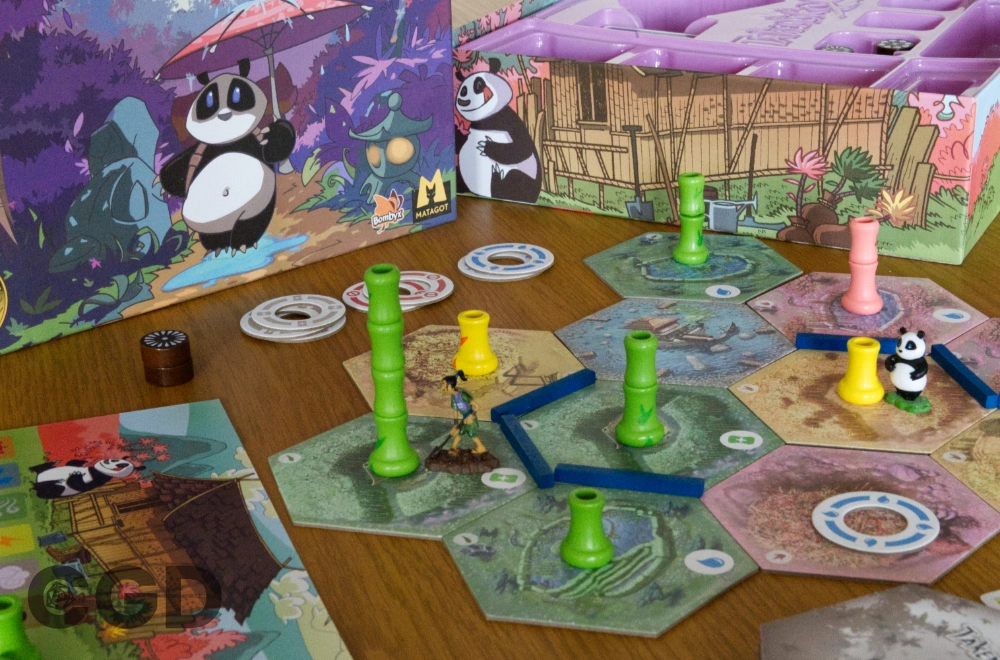
The rulebook is pretty straightforward, the player mats tell you what actions you can perform per round, including how many actions, albeit abstractly. We do wish they came with a little text so you can remind yourself about what you’re doing or looking for though.
We played the game without requiring to watcha video tutorial as the book explains what happens pretty clearly. The only one area that needed more clarification was what happens when you roll the weather die and move the panda - do we acquire this bamboo? Can you confirm we don’t - as there’s a mechanic that allows you to collect the bamboo the panda eats???
How it actually played out
Joshua bought this game as a present for Anjali… let’s just say that the first time round we sat down and got to playing it, Joshua couldn’t bear to look at it on discovering the distinct art styles. So the first time we played Takenoko, we opened the box and packed it back away.
Set-up and playtime
Takenoko sets itself up in about 15-20 minutes, considering most of the elements are placed or acquired during gameplay. You likely spend more time shuffling the elements (land tiles and score cards) than setting up initially.
Our preferred strategies
Its definitely tough to strategize for Takenoko, considering you’re reacting to things for most of the game.
We are of the opinion that it might be better to hold your cards close to your chest and try and achieve a good amount of them while collecting some higher scoring ones to achieve. This makes the game a bit more interesting, as you aren’t always sure who’s coming out on top, so you do your best to ensure you have the highest score possible before ending the game.
Our favourite house rules
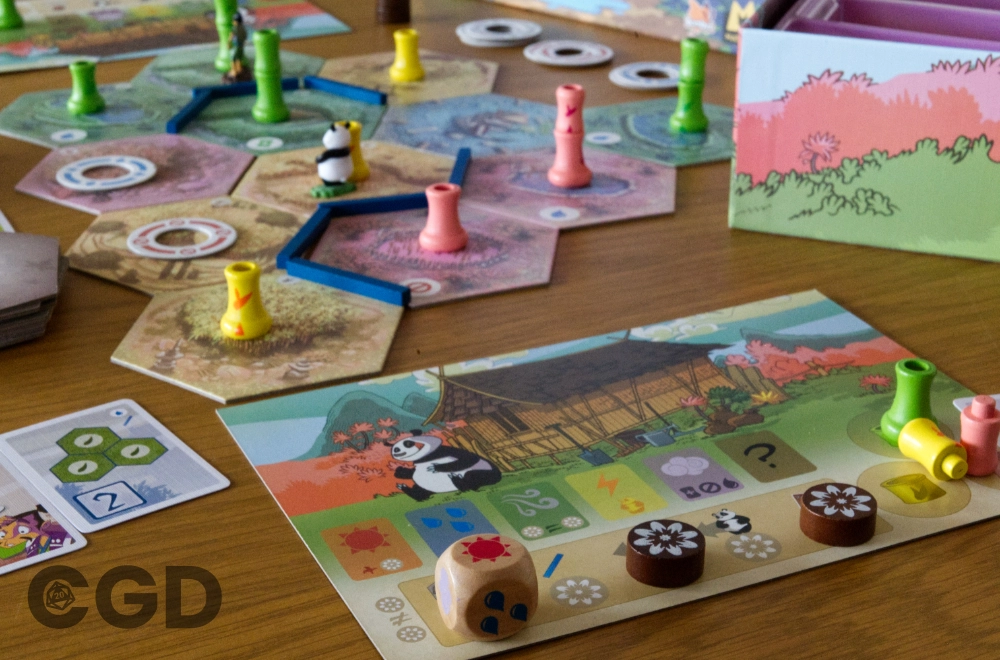
We thought about the various elements that felt unbalanced and reactionary, and Anjali explored various design choices to perhaps improve upon the gameplay.
Here’s some of our fun changes to the game rules so far:
- Instead of moving the gardener and panda in straight lines, you can move them in L shapes as a combination of 2 + 3, and stop short anywhere within the sequence. We found that this made movements a bit more tactical and allowed for players to move around the board with a bit more ease to achieve objectives, allowing for more of the board to be used.
- You cannot score till all the land tiles have been placed. This does artificially increase the length of the game, but it also gives us a chance to play with more of the games systems and also gives all players a chance to achieve some of the harder tasks.
How many games till you’re a not so zen gardener?
For veterans and casual players alike, you’re sure to have grasped the game by the second time. The mechanics are quite simple, and once you know what to expect from score cards, it’s easy enough to strategize for future games.
Publisher and their other games
Bombyx, a board game publisher, published Takenoko and Takenokolor, both of which are games about growing bamboo for pandas. The cyclical nature of the growth and consumption of bamboo is what makes Takenoko fun, though as the gardeners we can definitely say it doesn’t make for an easy trial.
Bombyx has also published other strategy games that are worth a peruse, with games like Refuge, Pixies, Humanity, Knarr, Elawa, Nicodemus and more.
/pic6177116.jpg)
/pic7467997.png)
Final thoughts
Its a game we might pull out once in a while to shake things up, when we’re not feeling up to something overtly complex and want to mess around by coming up with house rules. Perfect for an evening of shenanigans.
If you enjoyed reading about the resource management aspect of Takenoko, we’ve written an article that you can read right here, about what it is, our suggestions and other games that we have our eyes on.